Last update: May 15, 2023
Perspectives
Perspectives is a 2½-minute, traditionally animated 16mm film, (no computers used), created over nine months in 1979–1980 while I was enrolled in the BFA program at NSCAD, the Nova Scotia College of Art & Design.
One of the courses in my BFA program at NSCAD was "Film Animation", taught by Henry Orenstein.
Shortly after arriving in Halifax in August of '79, I became involved with the folks at AFCOOP, The Atlantic Filmmakers Co-op, (thanks to Lulu Keating), and was soon working (volunteering) as continuity and script on a 16mm independent short film.
AFCOOP was located in a multi-story, loft-like building on Barrington Street, which was also home to Doomsday Studios, an independent animation and film-production company owned by producer/director Ramona Macdonald, one of the founding members of AFCOOP.
Ramona was a driving force in the Atlantic Region's film community. She produced Perspectives and helped many other local animators bring their work to life.
The original music for Perspectives was created by Canadian musician and composer John S. Gray. The soundtrack played a major role in the international success of the film.
After Perspectives, John and I collaborated on various animation and music projects, as well as live performances at Toronto and Halifax art galleries.
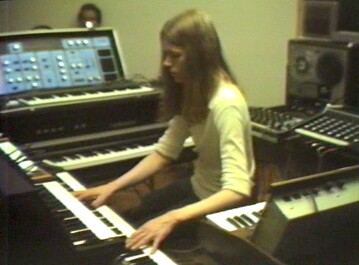
Visit John S. Gray's "Music and Compositions" web site here.
Perspectives: Production Notes & Trivia
Tagline: "We shroud the pure, harmonious, geometric symmetry in our cities with a fog of dirt, din, and disorder."
A "pitch meeting" for Perspectives was held at Ramona Macdonald's Halifax home in late 1979. Other Doomsday Studio members in attendance were Elaine Mackie, Rand Gaynor, and Peter Bromley.
I brought out several of my old pen-and-ink & color-wash paintings of geometric shapes and explained how I often saw them as "still frames" of moving objects that had come together to form "pleasing" compositions.
I made it known that I would like to bring those paintings to life with animation.
Ramona Macdonald agreed to have Doomsday Studios produce and fund my idea for a short, animated film.
This was the first of only two 16mm animated films I would create, and my first time using an animation camera and stand.
Peter Bromley kindly gave me lessons on how to use the equipment and I was soon creating a few short, test animations before diving into Perspectives.
During the 9 months it took to create Perspectives, I lived in a one-room apartment on the top floor of an old three-story house on Hollis Street in Halifax.
All the frames for the animation were drawn and painted on watercolor paper using a makeshift plywood desk outfitted with a metal animation peg bar that I set up by the window in my room.
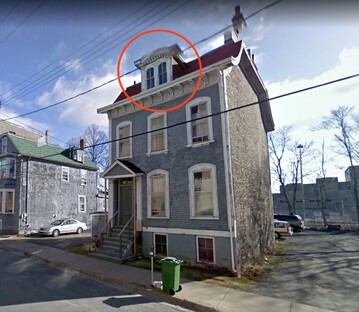
I fondly remember this time as my "artist in the attic" period.
All the perspective drawings in the film's hand-painted animation sequences were calculated using 2 and 3-point perspective techniques I learned while enrolled in an Interior Design class at Vancouver's Langara College in 1974.
The opening street scenes were shot in Montreal, Canada in late 1979 using a Pentax Spotmatic II 35mm camera.
For the two "birds-eye view" scenes, I went (unannounced) to the upper floors of several downtown office buildings and asked for access to rooms with "good views to the street below".
After a brief explanation that the photographs were to be used in a short animated film, the office managers usually granted their permission.
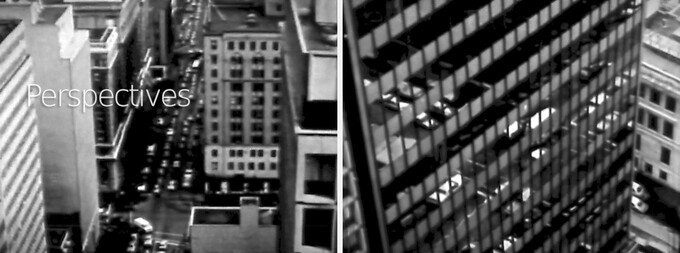
People were more accommodating in those days.
In early 1980, while paying the bill after a dinner at "Peacemeal", (a vegetarian restaurant in Halifax), I casually mentioned I liked the music playing in the restaurant and that it reminded me of Brian Eno's work.
John S. Gray, the fellow managing the restaurant, explained he was a composer and musician and that the music was his work.
I mentioned the short animated film I was working on and asked if he would be interested in creating the music and soundtrack for it.
He was.
This led to a collaboration of several years, with John and I working together on another animated short, and live music/animation performances at Toronto and Halifax art galleries.
To set the "mood" during the many months of drawing and painting animation frames in my attic, I repeatedly listened to "Little Fishes" from Brian Eno's "Another Green World" album.
While working on Perspectives, I was also enrolled in the BFA program at NSCAD, the Nova Scotia College of Art and Design. One of my classes was the 16mm film animation course taught by Henry Orenstein.
The college had it's own animation camera, stand, and film-making facilities, but with Henry’s approval, Perspectives was created entirely using the facilities at Doomsday Studios.
At the end of the Spring semester, Henry reviewed my progress and I received an A+ in “Film Animation” and 5 college credits from NSCAD for my work on Perspectives.
Coming from a television graphics design background I was more familiar with video production and editing.
To avoid dealing with film editing and film labs I shot the whole animation in one twelve-hour, marathon session, creating all cross-dissolves, matte effects, and opening & closing credits "in-camera"
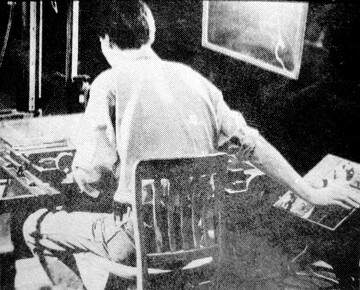
I attended only one of several international film festivals where Perspectives was an officially selected entry.
That was partly due to the organizers of "Internationale Filmwoche Mannheim 1981" kindly offering to pay my expenses while I attended the festival in Germany.
A great incentive for a "poor college student" like me.
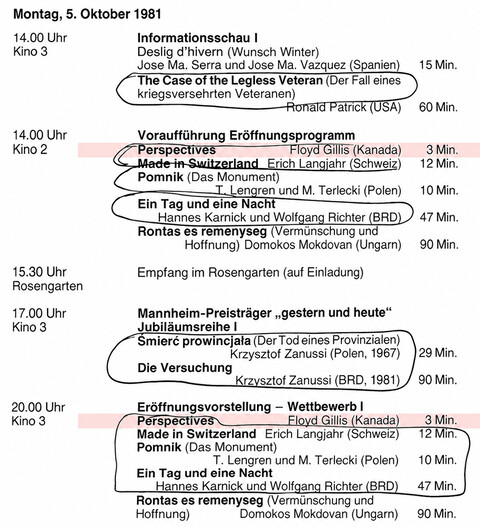
I was thrilled to see Perspectives screened together with films by internationally acclaimed directors, in a prestigious theater, with a large audience.
After one 3-hour screening, where Perspectives was included on the program, a major press conference was held in the theatre.
When it was over, and I was leaving the building, a festival official rushed up to me asking, "What happened? Where were you?"
I didn't realize I was expected to be on stage with the other directors for the press conference.
At the time, I never thought my little film or participation in the festival was such a "big deal".
It had all come too easy for me.
It was my first film.
I made it while enrolled in college.
I had almost unlimited access to film-stock and the high-end camera and animation stand at Doomsday Studios.
And, in addition to all that, Ramona took care of the film lab work and expenses, festival entry fees, paperwork, and shipping of the film to festivals around the world.
I should have been more aware... and more grateful.
A highlight of the festival (for me) was the evening with other film directors at a private dinner hosted by the mayor of Mannheim at an imposing nearby castle.
We were treated like royalty.
Another highlight of the festival was meeting "ES".
I learned there was a well established international film-festival "circuit" with events held around the world throughout the year, and ES was part of a group of independent filmmakers and festival organizers from Germany who spent much of the year traveling from festival to festival.
Weeks after returning to Canada, I began receiving annoying letters from the Mannheim hotel I stayed at. They were demanding payment for a DM 4 (approx. $1.75 USD) glass of orange juice.
Apparently "paid expenses" did not include fresh juice with breakfast.
Even though Ramona Macdonald owned Doomsday Studios and put so much into the production and promotion of Perspectives, her name is only included with 6 others under the "special thanks" section of the closing credits.
I still regret not giving Ramona a proper "Producer" credit on the film.
The original photographs and drawings used in the making of Perspectives have been lost. So has the original 16mm film and negative.
The only existing video is a low-resolution digital copy of the movie (included near the top of this page) that was pulled from a 16mm to 3/4 inch video tape transfer made in the late 1980’s.
On the making of the music for PERSPECTIVES by composer John S. Gray
On a blustery day in early March 1980, a young couple sat down at the end of a busy lunch hour, in the tiny restaurant where John S. Gray was employed. The dining room had nearly emptied by the time they ordered coffee and dessert. Without thinking about what he was doing, Gray ran the cassette of his summer 1979 drone piece, Dinner Music One. As the young man got up to pay the bill, he asked Gray: "Which Brian Eno piece are we listening to?"
Gray told him that it was one of his recent pieces that he was hearing. The young man then asked Gray if he would be available to add a soundtrack to a short experimental animated film. They exchanged telephone numbers and agreed to keep in touch. The young man's name was Floyd Gillis, and he added that he was anxious that they should start before too long, with a deadline looming.
After some negotiation with Professor Steve Tittle, John S. Gray moved his big polyphonic Moog synthesizer into the Dalhousie Music Department Sound Studio. In the booth, he placed the 203A on a table with the school's Moog Sonic Six sitting on top of it, both keyboards playable from the one stool. It just happened to fit perfectly in that position.
Gray called Gillis. Gillis was brimming with ideas, wanting to see Gray as soon as possible. They made arrangements almost immediately. Gray booked the Experimental Sound Studio for three hours in the afternoon, and at the appointed hour they met there. Gillis had a sheaf of storyboard sketches, which he took Gray through, explaining the transformations and events in his short film. Gray fired up all the synthesizers, patched up one of the open reel decks as an echo box, and opened Gillis's ears to the sonic possibilities.
The next day Gillis took Gray into a little film theatre on Argyle Street, part of an institution that had thus far escaped Gray's notice: The Centre for Art Tapes. In the theatre he showed Gray the final cut of his still-silent film, and having seen it through twice, Gray immediately knew what he was going to do with the sound-track. Once the rough elements were assembled, the actual synchronous sounds would have to wait until Gillis physically hauled a 16mm film projector up to the studio.
The whole project had Gray very excited, and engaged.
Up at the Dalhousie Studio, Gray began seriously exploring the sonic possibilities of the big Moog 203A, trying various configured echoes and other tricks.
The weather had warmed up, and so Gray decided to capture some genuine street sounds for the opening scene in Perspectives, which depicted a series of still photos of Montreal. To do that, Gray stuck microphones out the open studio window, capturing as much noise as he could, later editing together the most obvious gear shift changes and impatient car accelerations as he was able; there was also an incessant barking dog. And then to fatten up the layered sounds of those passing cars and pedestrians, he added several synthesized car horns, truck horns and police sirens to spice up the mix.
When Gillis brought up the big projector just a short time later, he was very impressed with Gray's city noise collage. That most labor-intensive part of the soundtrack was already complete. Various characteristic synthesizer sounds were created using Minimoog, Moog 203A and Arp 2600, to accompany the animated elements as the cityscape turns itself into geometric forms, each of them moving in ordered patterns. Those sonic elements came together very rapidly, and they only had a few re-takes to make certain that sounds matched each visual event. They virtually got the whole thing done in one night. Gillis had a half-track master in his hands, to take to the film print lab.
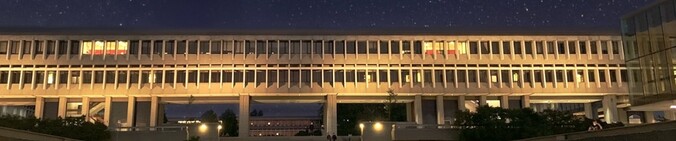
In early 1982 I enrolled in an "Art & Computers" animation course at Simon Fraser University in Burnaby, BC. The class was taught by Jerry Barenholtz and featured a state-of-the-art Evans and Sutherland "Picture System 2" running the "GRAX" software interface.
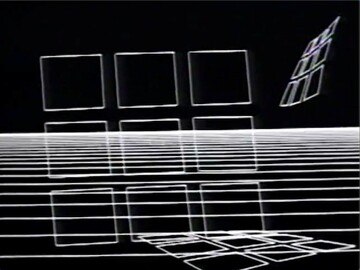
After a few weeks on the system, I was able to re-create the challenging "blue boxes" segment from Perspectives - a 40 frame cycle that had originally taken me 3 months to make by hand.
The system could only display B&W lines, but I could manipulate the motion of the wire-frame boxes in real-time using software commands or a dial-box attached to the computer.
Thanks to this experience I never made another traditionally animated film again, and have worked exclusively on computer animation systems since then.
Later that year, John and I collaborated on Time Lines.
Time Lines was created on the Evans and Sutherland system at Simon Fraser University and was recorded frame-by-frame using a 16mm film camera pointed at a high-resolution B&W monitor.
Contrary to Perspectives, where the soundtrack was created after I had completed the animation, the soundtrack for Time Lines was created by John before I started building the animation.
Only a 29-second segment of Time Lines still exists, but a full version of John's haunting soundtrack has been preserved.
2017 ALTERNATE VERSION
In the Spring 2017, I created a "Thirty-Seventh Anniversary Digital Remaster" edition of Perspectives using computer animation.
The original photographs of Montreal street scenes no longer existed so they were re-created by "screen-grabbing" and "stitching" still frames from a 640x480 digital copy of the old film.
All the street scenes were enhanced with subtle CG animation effects, and the original hand-painted segments of the old film were re-created using Houdini 16.0 software.
The final animation was output at a resolution of 1280x960, and the soundtrack was pulled from an audio cassette archived by John S. Gray.
For an interesting comparison between the 1980 and 2017 versions of Perspectives, here's a synced, side-by-side version of the two animations.
For more information related to Perspectives, click on the image links below...


