Last update: February 12, 2023
Omnibus
These pages are a (rambling) collection of memories and stories from my days as a creative director/animator with Omnibus Computer Graphicss in Toronto and New York City.
I worked at Omnibus from late 1983 until their bankruptcy and collapse in 1987.
Most of these events happened over 40 years ago, so it’s likely I’ve mixed-up and/or forgotten some names, dates, and other details from that time. My apologies in advance to anyone I’ve left out, and also to anyone who may have preferred to have been left out.
If you think something should be corrected, added, or deleted, please send an email to the address under "Contact".
Canadian CG companies
In early 1983 there were only two commercial CG facilities in Canada; Omnibus Computer Graphics and Vertigo Computer Imagery. Omnibus was a much larger company located in Toronto and had already been around for several years as Omnibus Video. Vertigo, where I worked, was a small start-up located at 119 West Pender Street in Vancouver.
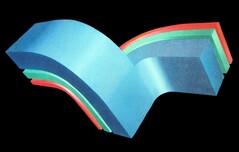
The 1986 World's Fair (Expo '86) was coming to Vancouver, and it looked like Omnibus had a lock on any CG work that might be awarded. Even so, Omnibus sent Rick Balabuck to Vancouver to check-out possible competition from Vertigo, and maybe do some recruiting.
I think Fred Daniels, Mike Parker, and Steve White, (the principals at Vertigo), may have welcomed Rick's visit as a prelude to establishing a co-production arrangement with Omnibus and getting a share of the Expo '86 animation dollars.
I spent a day with Rick going over our CG capabilities and showing him what we were working on, including my city drive-through animation that was still in production. He seemed especially interested in the 3D modeling and my use of the BASIC programming language to animate cameras and objects, and to pre-visualize the path of those cameras and objects on a non-interactive system.
Not long after Rick's visit I was recruited to join Omnibus.
Besides my CG experience at Vertigo, I had a background in 16mm film animation, and years of experience as a television graphics designer with CBC Vancouver. It probably didn't hurt that Dan Philips, a set-designer friend of mine from the old CBC days, was also the Creative Director at Omnibus.

In late 1983, I joined Omnibus in Toronto as an Associate Creative Director, with the understanding I'd be promoted to the Creative Director position at Omnibus's new facility scheduled to open in New York City in early 1984.
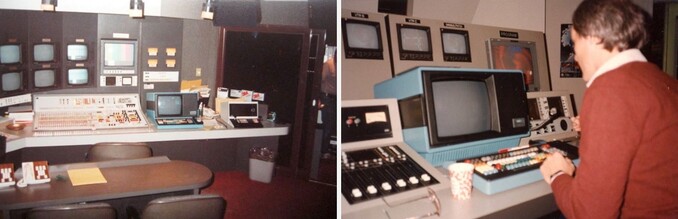
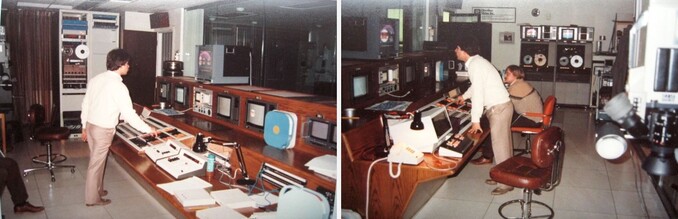
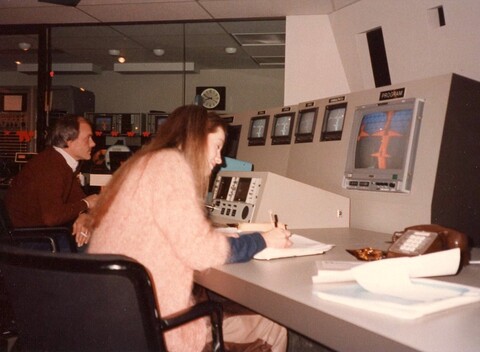
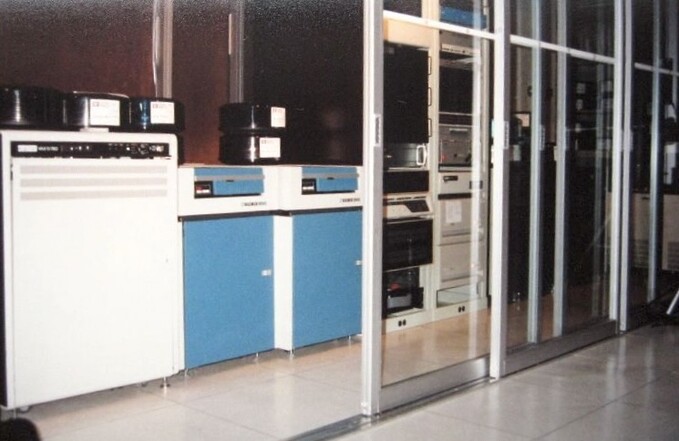
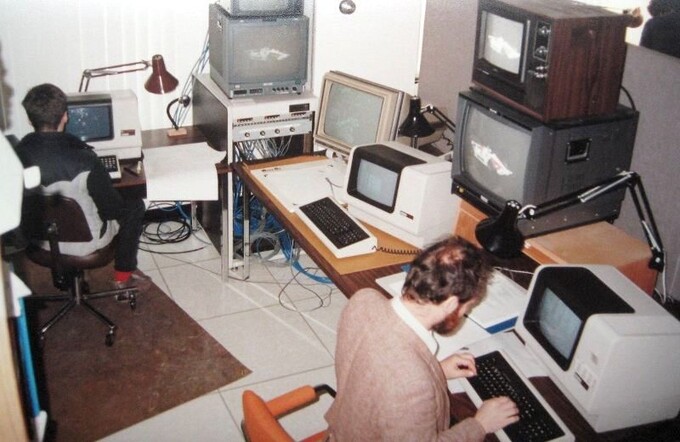
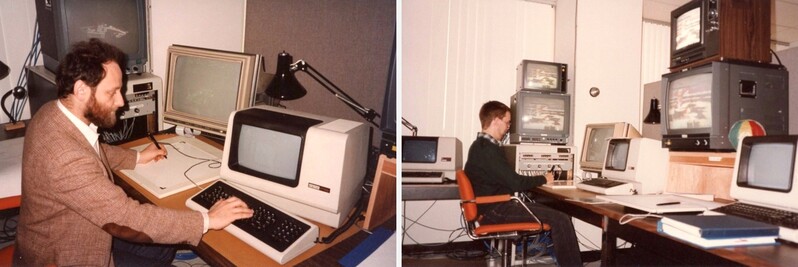
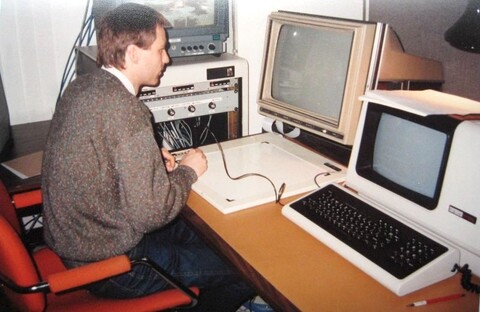
Below are a few images from the Toronto office between late 1983 and early 1984. (It's a shame how few photos I have from that time, making this is a meager representation of the facilities and staff.)
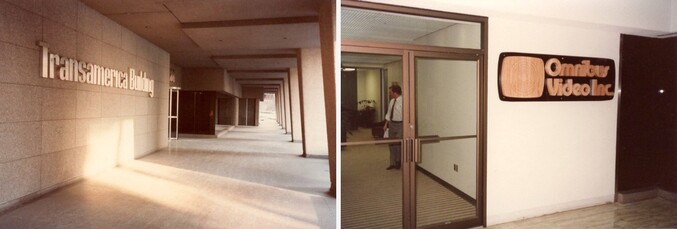
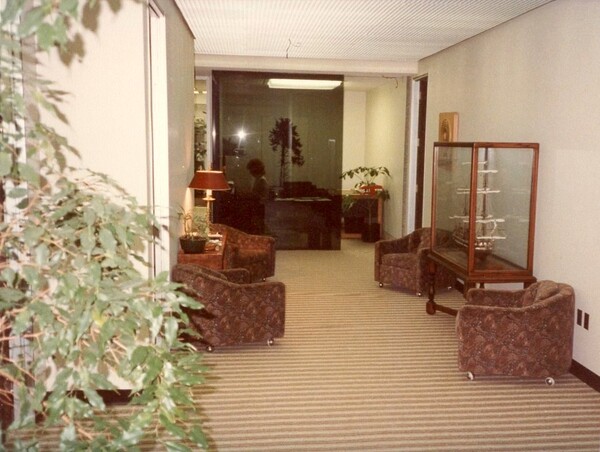
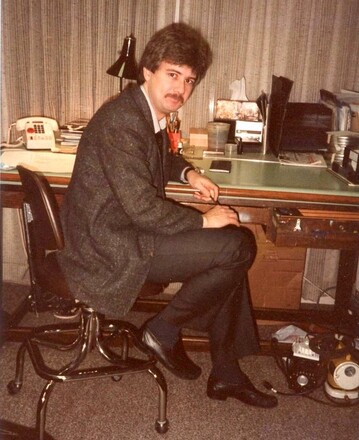
While in Toronto, waiting for the New York facility to open, I shared an office with Dan Jex.
Sharing an office with Dan for over 6 months was... challenging. He would be on the phone all day long, chatting-up people with his smarmy salesman banter. And, after almost every call he'd slam down the receiver and snarl, "jerk", "asshole", "motherfuc*er", or something similar. It was a bit stressful, and colored my view of salespeople for years afterwards.
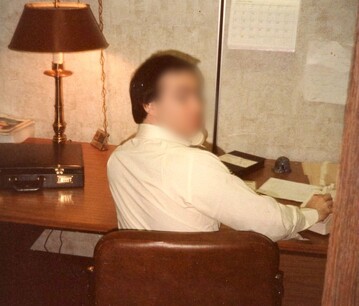
David Howe, on the other hand, was a nice guy and talented artist who made images and storyboards the traditional way with illustration board, paint brushes, air brush, colored pencils, felt pens, and so on. His office was just across the hall from Dan's.
Omnibus Toronto was both a video effects house and a computer graphics facility.
Wonder Works
In early 1984, while still at Omnibus Toronto, I attended a meeting with clients from PBS, (WQED & KCET), regarding an up-coming anthology series titled "Wonder Works”. I was assigned the task of creating opening animation concept storyboards to be pitched to PBS. One of my storyboards featured a fly-through of a colorful and stylized environment loosely based on MC Escher’s “Double Planetoid” print.
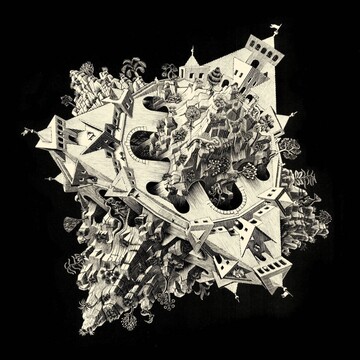
The client loved the boards and Omnibus was awarded this prestigious, and well funded, project. (Helping to raise my status with Omnibus management.)
Soon after, however, Omnibus completed purchase of the Foonly F1 computer and digital film recorder from Triple I (Information International Inc) and installed them in Omnibus's new L.A. facility on the Paramount lot.
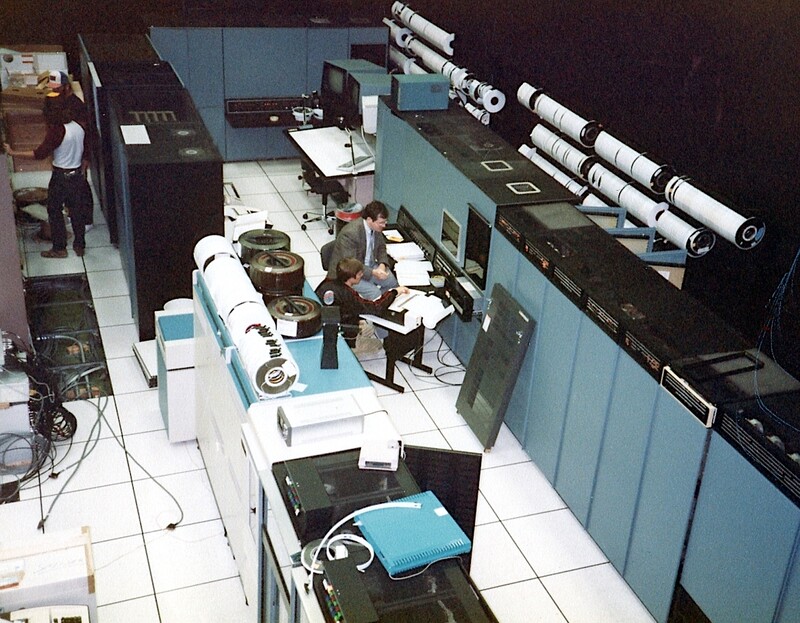
John Pennie, Omnibus President and CEO, saw the high-profile Wonder Works project as a great way to showcase the film capabilities of the new L.A. facility.
Art Durinski, formerly with Triple I, was brought in as Creative Director of the L.A. office, and the Wonder Works project moved to L.A.
I was thrilled. Having been "awed" by Triple I animations at SIGGRAPH '82, I looked up to anyone associated with those works, and was excited by how my storyboard design would come to life.
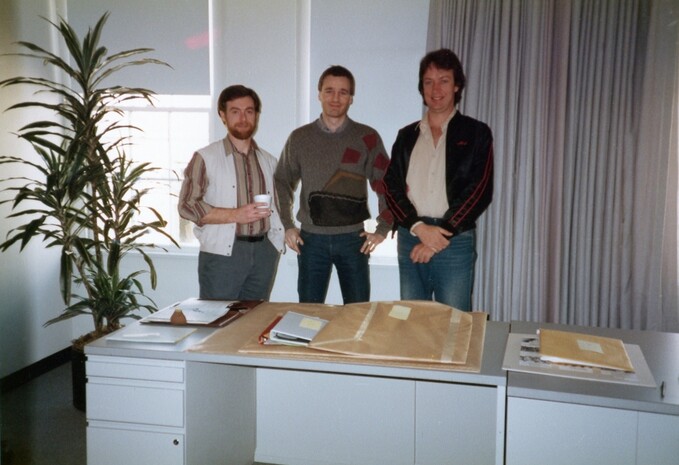
Weeks later, I went out to L.A. during the early stage of production, but my involvement was minimized to the point where I was no longer needed, (wanted?). I returned to New York and the project went ahead without me.
When I saw the final animation, I was disappointed. Not only did it not look anything like my original storyboard, it was also visually and technically... weak.
Station Package
While still in Toronto I was asked to design and create a "Television Station Package". In those days, it was too expensive for local stations to have their own computer generated on-air graphics, so several companies started marketing "generic" station packages as an affordable alternative.
By providing small stations with "network quality" graphics and animations at a relatively low cost, Omnibus could make a tidy profit by selling the same package to multiple stations. (That was the idea, anyway.)
The animations usually included looping elements, and were built to be easily modified by Omnibus or local broadcasters by inserting custom ID's, logos, program titles, promos, and so on.
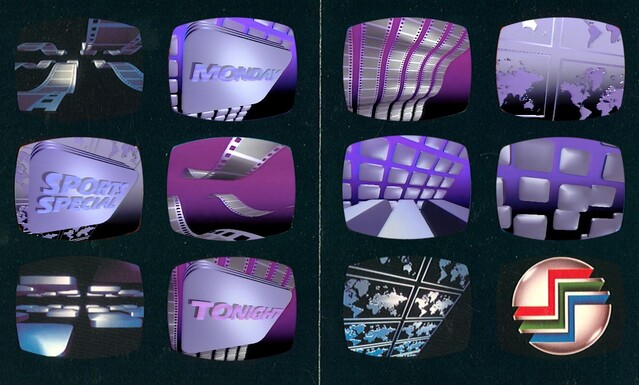
I'm not aware of Omnibus ever selling any of these station packages. Looking back on them now, I can understand why.
NYIT
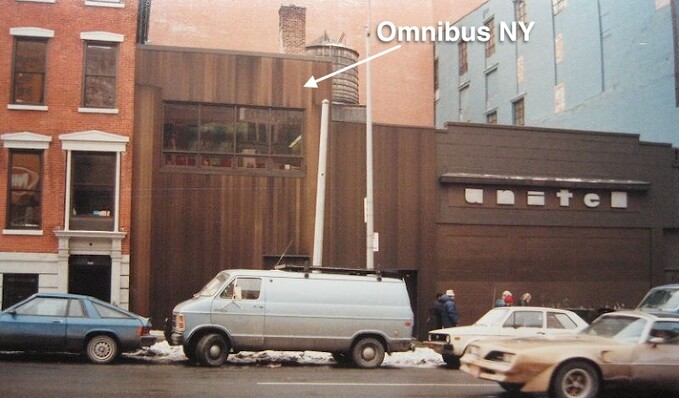
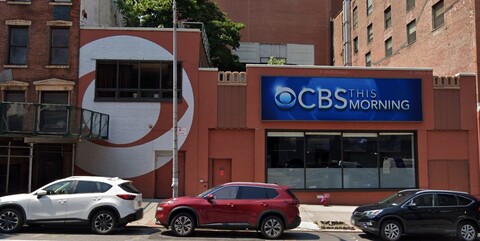
By the second quarter of 1984 the renovations at the Omnibus NY facility, (in a building leased from Unitel video), were nearing completion. I made a couple of trips to New York, with Dan Krech, to interview candidates for the up-coming technical director and animator positions, and to see how the renovations were coming along.
The plan was for the New York facility to use 3D software licensed from NYIT (New York Institute of Technology). Omnibus Toronto had already been using NYIT's "Tween" system for several years, so it seemed like a good fit.
I don't know what kind of a deal John Pennie had with NYIT, or whether he was still in the negotiating stage, but he found it necessary to bring most of his senior creative and technical personnel (around 14 of us) to a group meeting with Louis Schure at NYIT.
Perhaps John wanted to impress on Louis just how serious he was about securing a license for the 3D software.
We all departed from Toronto for our short flight to New York, and soon after landing at La Guardia, we were on the Long Island Expressway heading for Old Westbury and the NYIT campus.
Joe Martin (Director, President-Northern Division, and Secretary of the Company, Toronto) was driving, with 5 or 6 of us in the car. As soon as we got on the LIE he started speeding and weaving in and out of traffic. Hearing signs of distress from some of the others, I looked over at Joe and saw he was totally calm and clearly aware of all the traffic around us. I was impressed and asked him where he had learned to drive like that. He answered, "I used to be a truck driver". I sat back and enjoyed the ride.
I've written about my high regard for those who worked on animation at Triple I. Well, the folks at NYIT were some of the "gods" of the CG world.
At the time you had Alvy Ray Smith, Ed Catmull, Lance Williams, Paul Heckbert, Pat Hanrahan, and many other big names, all working together at NYIT. These pioneers laid the groundwork and went on to establish the Computer Graphics industry as we know it today.
Being on the hallowed grounds of the NYIT campus was almost a religious experience for me, like entering a grand cathedral, (of CGI). I'm sure I even heard the rich sounds of a pipe organ wafting through the trees. It was an exciting, and humbling, experience.
A Brief History of the New York Institute of Technology Computer Graphics Lab
All of us were sitting around a large conference table waiting for Louis Schure to join the meeting. He finally arrived, and we were all introduced. Then, he and John had a discussion at the other end of the room. I couldn't hear what they were saying, but it looked tense and serious.
We were not given a tour of the NYIT facilities 😡, so after the meeting with Louis Schure several of us went into Manhattan to check on the progress of the renovations before heading back to Toronto.
The construction work was finishing-up and some equipment had already arrived for installation. The opening of the New York facility was scheduled for early June.
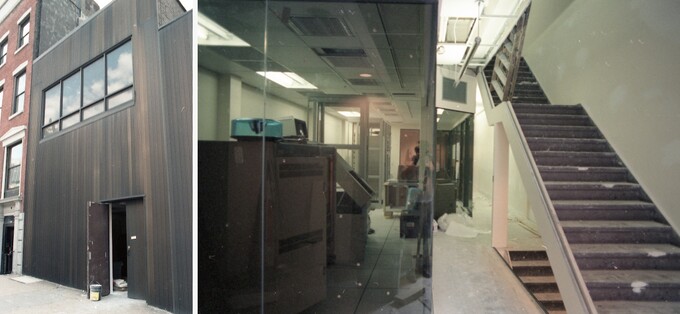
Sometime in April or May, we were told the deal with NYIT had fallen through and the New York facility would have to open without any software.
Yes, a multi-million dollar 3D animation facility in the middle of Manhattan would be opening without any 3D animation software!
On the other hand, Dave Sieg, Omnibus VP of R&D, and responsible for the computer and video equipment, did a great job making sure all the hardware was installed and functioning properly in time for the opening.
Omnibus NY Opens
I moved to New York City at the end of May and, together with other staff members, began settling-in, getting comfortable with the new facility, and thinking about work.
Here's a list of the NY staff at that time...
Paula Blashka: Sales
Stan Cohen: CG Artist
Henry Frenzel: Technical Director, Editor
Floyd Gillis: Creative Director, etc.
Sonya Hafferkorn: CG Artist
George Heywood: Vice President and General Manager
Nadeen Kaplan: Production Co-ordinator
Erik Ladd: CG Artist
Barbara Levy: Sales
Jeff Marvin: Producer/Sales
Paula Tannenbaum: Assistant to George Heywood, Receptionist, Den-Mother
Omnibus NY was located in a small two-story building.
The basement had an open office arrangement for Paula Blashka, Jeff, and Barbara.
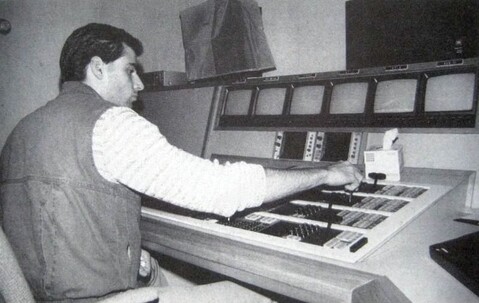
The ground floor, with its main entrance, housed our computer and video equipment room, along with Henry's edit suite at the back.
The second floor had George's office at the front, (the only room with windows), Paula Tannenbaum's reception area, my office, and a large open room where Stan, Sonya, and Erik had their desks. This was also where the SGI workstation, several VT-100 workstations, and a digitizing table were located.
At the back of the second floor was a small stairway and narrow corridor that led to Nadeen's office, the conference room, and a couple of spare offices for future employees. This area was actually part of the building next door.
Along with all the computer and video equipment, we had a lot of new office furniture. One of the most expensive pieces was a custom-built table for our conference room. It must have been at least 10 feet long, with a beautiful black-grained surface fabricated from a single piece of thick wood.
No one had done the measurements, and it proved impossible to rotate the tabletop into the narrow corridor to the conference room. So, it was taken out to the front of the building and cut in half with a power saw on the sidewalk of West 57th Street.
It wasn't long before we held our big "Open House" for New York ad agencies, national television networks, and video post houses.
We had some impressive technology on display; a VAX 11/780 with its huge disk drives, an Ikonas frame buffer, 9 track tape drive, SGI (IRIS 2400) workstation, digitizing table, several VT-100 based workstations, and a state-of-the-art video editing suite with Ampex switcher, ADO, and two 1" machines.
George Heywood even had an impressive 6 foot long, wall-mounted shark to show-off in his office on the second floor over-looking West 57th Street.
Only one thing was missing: Software.
We didn't have the ability to create geometry, animate, or render, but we did have the (not so impressive) Omnibus demo reel on a constant loop. The highlight of the night ended up being demos of "Flight Simulator" running on the SGI workstation.
Bamberger's
Somehow, we were soon awarded our first job, with a New York area department store called Bamberger's. They were looking for a computer animated segment in a commercial to highlight their electronics department, and they liked our storyboards and presentation.
Of course, without any animation software, most of the production would have to be done in Toronto. However, I noticed the Bamberger's logo could be created solely with straight lines and arcs, so I decided to build the 3-D logo geometry in New York and send it to Toronto to be animated.
Paula Tannenbaum had an IBM PC for word processing, and I used that to build the Bamberger's logo.
In those days, "graphics" was an option on the IBM PC, and Paula's didn't have it. So, when I needed to check the progress of my logo I'd copy the data to a floppy disk and run over to the Radio Shack several blocks away on 57th Street. Over several days and 3 or 4 visits to Radio Shack, I finally completed the logo geometry and sent it to Toronto.
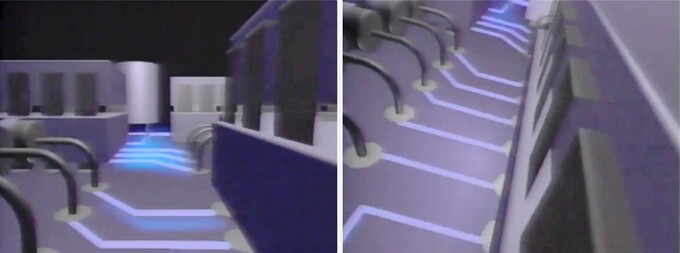
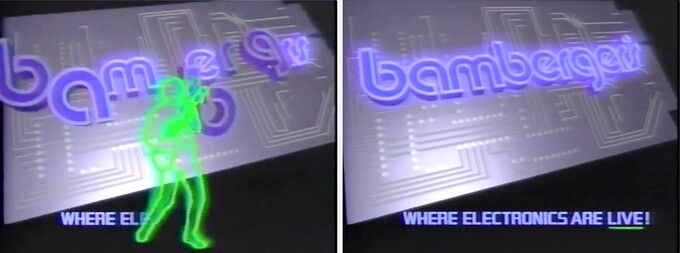
Most of the other geometry and animation was created in Toronto, including Sonya Hafferkorn's wireframe guitar player created on their NYIT "Tween" system. Unfortunately, due to the length of time the renders were taking, this spot was animated at 15 frames per second, instead of the usual 30.
I continued to supervise the project from New York, and eventually brought the clients up to Toronto for the final edit. Everything went smoothly, (that the client was aware of, anyway), and I flew back to NY that night with happy clients, and a master tape of Omnibus New York's first completed project.
Here's the surviving version of the animation.
Scn-Dis-Assmblr
We started using "scn_assmblr", the animation and rendering software originally written by Frank Crow while at Ohio State University. It's not clear whether Omnibus picked up a public domain version of the software or purchased the source code from Ohio State, but it was extremely buggy and we were soon calling it "scn_dis_assmblr".
Dave Gordon, a math and coding whiz with extensive experience in CG and writing renderers, joined Omnibus NY (from Vertigo) in the summer of 1984. Dave worked on debugging "scn_assmblr" and making it more useful for production until a new renderer could be developed in-house.
Omnibus also purchased the source code to "Preview", animation software from Wavefront Technologies that ran on the Silicon Graphics workstation. This became our primary animation software.
At the same time, the R&D folks up at Omnibus Toronto, led by Greg Hermanovic, Kim Davidson, and Paul Breslin, had gone into high-gear developing software for in-house use. We soon had "p-tools", with its collection of stand-alone programs used for polygonal geometry creation and manipulation, and "f-tools", another group of programs used for image processing and compositing.
Using makefiles and shell scripts, we could string together commands to pipe input and output from one "tool" to the next. (This was actually the text-based precursor to the procedural nodes used years later in SideFX's PRISMS and Houdini software.)
We now had software that allowed us to fully complete productions in New York, and began taking on more projects.
MSG
Another of our earlier productions was created for Madison Square Gardens. The client was Kathy Landman of K. Landman Designs.
WPIX 11
Here's an excerpt from a fun (and challenging) movie-open we created for WPIX 11, a local New York City television station. Several versions of the 45 second animation were created for different days of the week, time of day, and special movie events.
As reference, we used city engineering maps, commercial street maps, and hundreds of photographs. We also had a large map that included 2-D outlines of all the buildings and major structures from the Southern tip of Manhattan up to Central Park. The outlines were digitized by hand, then extruded with random values into 3D blocks.
Landmark buildings like the World Trade Center, Empire State Building, Chrysler Building, and so on, were built separately and added to the geometry of the city.
Additional Production Details and Credits
A ten week project with a budget of approximately $70,000.00 US.
Client: WPIX, Inc
V.P. Creative Services: Paul Bissonette (WPIX)
Creative Directors: Floyd Gillis, Miles Tanaka (WPIX), Alberto Ne (WPIX)
Animation: Floyd Gillis
Account Director: Paula Blashka
3D Modelling: Floyd Gillis, Stan Cohen
Technical Director: Henry Frenzel
Rodian Paul a talented animator, coder, and shit-disturber who specialized in writing image processing routines joined us (from Vertigo) in early 1985.
Dave, Rod, and I were kind of a team back at Vertigo in Vancouver, and it was great to have the three of us working together again in New York.
Shell Oil, Brazil
Another ambitious project from the early days at Omnibus NY was for Shell Oil, Brazil. The concept was to show the evolution of automobiles and Shell Oil cans from the 1950's to the 1980's.
We came up with storyboards showing a series of cars traveling along an elevated mountain highway and through several tunnels. The tunnels would serve as the transition points from older-to-newer cars, while tunnel exits would be constructed of older-to-newer Shell Oil cans.

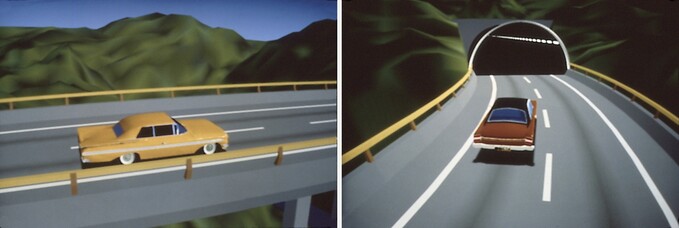
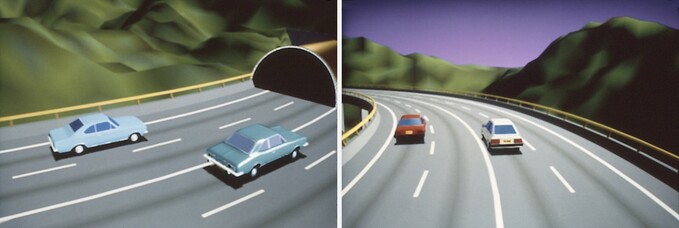
I first met the producer from Brazil, Humberto Almeida, in George Heywood's office. He was handing George a briefcase filled with cash, much like you'd see during a drug deal in the movies. It contained about $30,000.00, and was the first-third payment for the 30-second commercial. (Yes, CG animation budgets were "relatively" better in those days.)
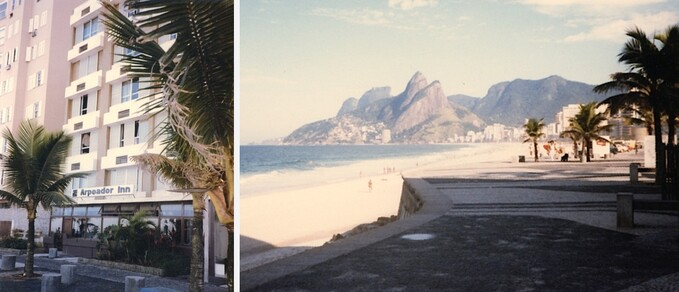
Jeff and I flew to Rio de Janeiro to "conduct research" on the nearby mountains and highways that would be re-created for the animation. We also went to Sao Paulo to meet with the clients, probably at the Standard, Ogilvy & Mather offices. While there, we went over the storyboards, refining details and coming up with a revised ending.
We spent a lot of time with Humberto, who took amazing care of us during our stay in Rio. One night, after dinner, we were advised to stay with Humberto and his wife in their apartment. (Was it too late to head back to the Arpoador Inn in Ipanema?)
Jeff and I made ourselves comfortable on a couple of sofas in the living room, while Humberto and his wife sealed themselves in their bedroom... with a large gun! Apparently, crime was a big problem in Rio at the time.
Jeff and I had a restless sleep that night.
Back in New York, we began building geometry for the fractal mountains, highways, and oil cans, using "p-tools" linked together in makefiles and shell scripts.
The 3D geometry for the cars was built in Toronto by Rick Balabuck, Linda Bel, Rob Marinic, Mark Mayerson, Ron Plante, and Steve Strauss.
Due to memory and hardware limitations, we had to keep the poly counts low in our geometry. We could use point colors to add some detail to the surfaces, but we still didn't have bump mapping or shadows. And, I believe, the oil can labels were our first use of texture mapping.
Humberto returned to New York a couple of times during the production for animation reviews and to drop-off briefcases filled with cash.
Additional Production Details and Credits
An eight week project with a budget of approximately $90,000.00 US.
Client: Shell Do, Brazil
Agency: Standard, Ogilvy and Mather, Brazil
Producers: Paulo Dantes (Movi and Art, Brazil), Humberto Almeida (Zillion, Brazil/L.A.)
Creative Directors: Carlos Prosperi (SOMB), Clovis Calla (SOMB), Floyd Gillis
Animation: Floyd Gillis
Account Director: Jeff Marvin
3D Modelling (Environment and oil cans): Floyd Gillis, Eric Ladd
3D Modelling (Cars): Rick Balaback, Linda Bel, Rob Marinic, Mark Mayerson, Ron Plante, Steve Strauss
Technical Directors: Dave Gordon (Software), Henry Frenzel (Video)
Production Co-ordinator: Nadeen Kaplan
The clients in Brazil were very happy with the final production and they returned to Omnibus for two more commercials. One was produced in New York and the other in Toronto.
The New York production, for Shell Oil, featured playful animations of musical instruments transforming into oil cans. The client was very happy with the 10-second spot.

Additional Production Details and Credits
Client: Shell Do, Brazil
Agency: Standard, Ogilvy and Mather, Brazil
Producers: Paulo Dantes (Movi and Art, Brazil), Humberto Almeida (Zillion, Brazil/L.A.)
Creative Directors: Clovis Calla (SOMB), Sonya Hafferkorn
Animation: Sonya Hafferkorn
Account Director: Jeff Marvin
3D Modelling: Stan Cohen, Sonya Hafferkorn, Eric Ladd
Technical Director: Henry Frenzel
Production Co-ordinator: Nadeen Kaplan
The Toronto production, (I can't remember the client or product), created a little later and output to film, (for some reason), was an embarrassing disaster.
The project was so far behind schedule that Jeff had to hand deliver the film in order to make the editing deadline. He didn't get a chance to preview it, (did anyone?), because Erik had flown down from Toronto to pass the film to Jeff at JFK before Jeff boarded his flight for Brazil.
In São Paulo, when the film was finally transferred for the edit, everyone could see it was full of glitches, and unusable. People were shaking their heads at Jeff and asking why he had flown all the way to Brazil with that "piece of shit film".
Creation of the Universe
A spiral galaxy animated for "Creation of the Universe", a science documentary written by Timothy Ferris, and starring Timothy Ferris, Murray Gell-Mann, and Stephen Hawking, with music by Brian Eno. (Regrettably, I did not get to meet Brian, one of my heroes.)
The PEL
I don’t recall even being aware that we were getting the PEL. I came into the office one morning and there were these guys unpacking and installing a huge machine in our computer room.
The PEL was one of the first digital disk recorders. It’s 22 Fujitsu “Eagle” hard drives filled 4 of our equipment racks and, according to Omnibus PR, had cost over two million dollars.

It was thrilling to hear about the machine’s (supposed) capabilities and I asked the head engineer if it could also play recorded video in reverse. He looked at me like I was some kind of idiot and growled, “NO!”, in a thick Russian accent. Then, ignoring me, went back to the installation.
Those guys were not very friendly.
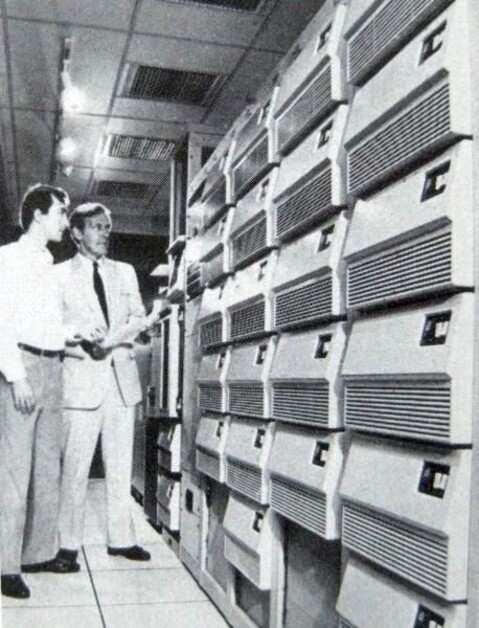
To achieve realtime record and playback, each frame of video was split across all the drives. Unless all the disks were in sync and working perfectly, the machine could not function properly.
I’ve read that the PEL was capable of holding 7400 frames (4.1 minutes) of NTSC-resolution video. I don’t recall it ever being able to hold more than 30 seconds.
We occasionally used the PEL to play back matte elements when Henry needed a 3rd machine for more complex edits. Other than its value to Omnibus in marketing and PR, it was a waste of money.
ESPN
Over the years we did a lot of work for ESPN. These are just a few of the surviving pieces.
By far, the biggest project we did for ESPN was the "ESPN City". Jeff Marvin and I went up to ESPN Headquarters in Bristol, Connecticut to pitch the idea. The concept was to build a "CG City" with different venues, stadiums, and so on, that could be customized with ESPN branding. Numerous animations could then be built in different parts of the "city" to promote up-coming broadcasts and events.
ESPN loved the idea. Their only reservation was that the scale of the project was too big, and questioned whether we could pull it off. I had already built and animated a smaller CG city and showed them my old drive-through animation made while at Vertigo.
We got the job.
After completing the initial layout of the city, I drew-up plans and elevations of all the buildings and other structures. Together with Stan, Sonya, Erik, and Rod, we built the geometry for the city over several weeks.
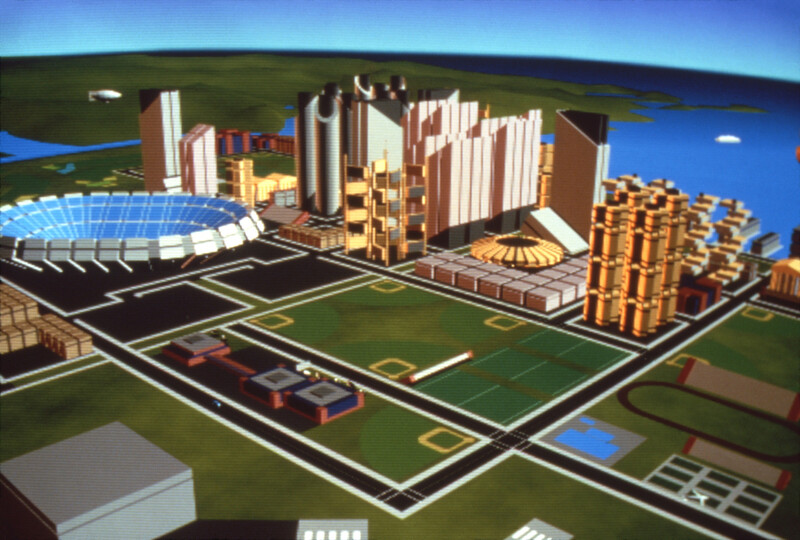
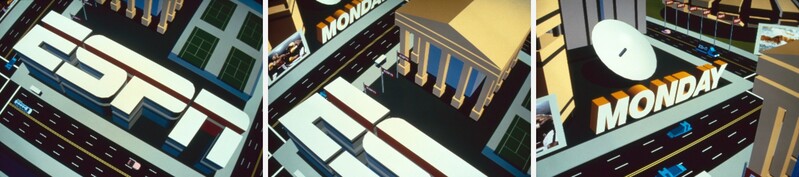
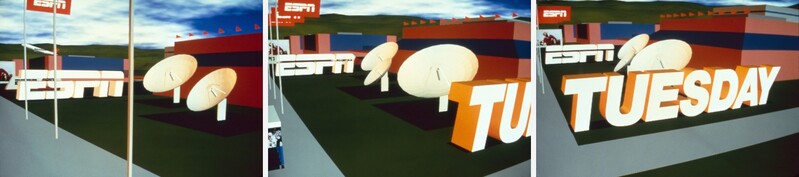
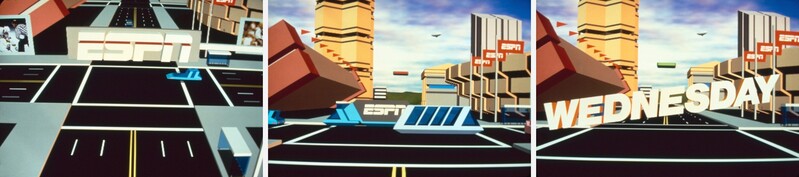
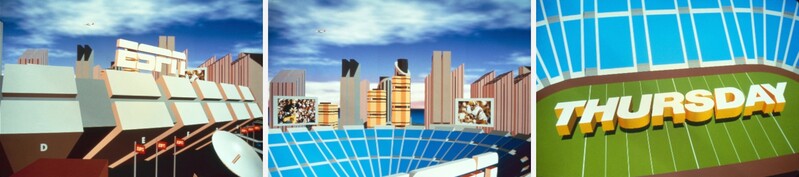
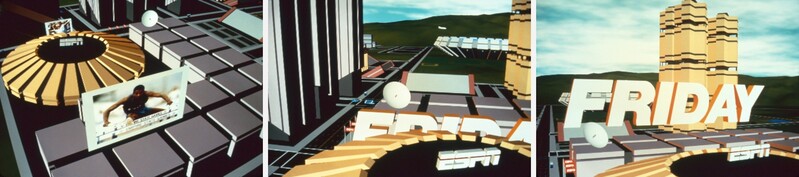
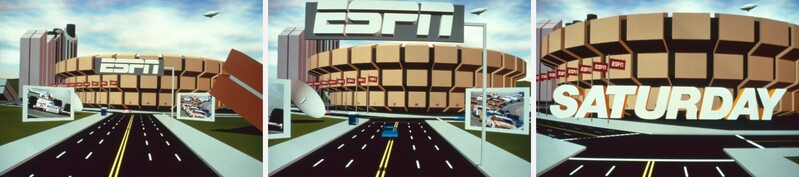
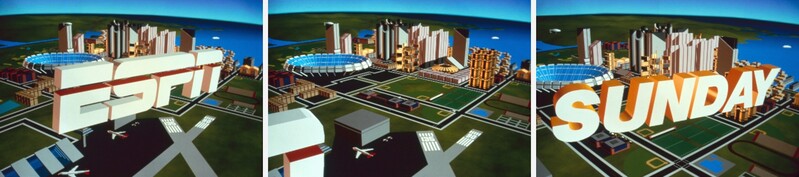
The ESPN "City" project continued for well over a year, with new stadiums, buildings, and other details being added when needed.
Additional Production Details and Credits
A year-long project with a final budget of approximately $200,000.00 US.
Client: ESPN, Inc.
Producers: Ralph Eno (ESPN), Bill Ketchum (ESPN)
Creative Director: Floyd Gillis
Account Director: Jeff Marvin
Animation: Floyd Gillis
3D Modelling: Stan Cohen, Floyd Gillis, Sonya Hafferkorn, Erik Ladd, Rod Paul
Technical Director: Henry Frenzel
Production Co-ordinator: Nadeen Kaplan
ABC Sports
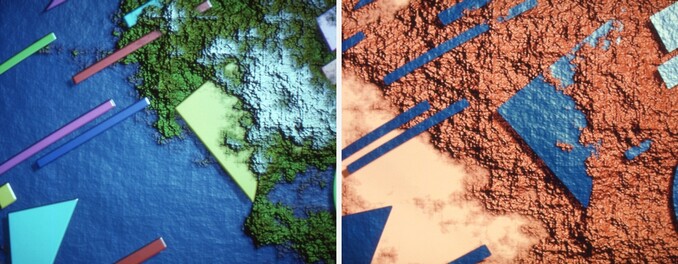
Around early 1985, Dave Gordon wrote an experimental displacement shader that could be used to create some impressively textured images. I started playing around with it, using 8-bit B&W fractal patterns combined with flat geometric shapes, and loved the results. We were excited by this "new look" and anxious to pitch it to one of the networks.
Jeff Marvin set-up a meeting with ABC Sports and I put together some test frames and animations.
It wasn't long before we were in an imposing office (high floor with spectacular views of Manhattan) of an ABC Sports executive, ready to impress him with our new logo treatments. (I can't remember his name, maybe... "Greenberg"?.)
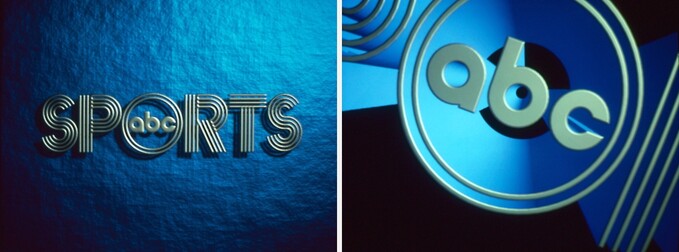
"Greenberg" inserted the 3/4" tape to view the demo, while Jeff and I sat back and exchanged smiles. After the demo finished, "Greenberg" stared silently at the blank screen for several seconds, then slowly turned toward us and said, "This is the worst shit I've ever seen".
Well, that didn't go well. And, we never did do any work for ABC Sports.
The funny thing is, those ABC Sports logos were used for the next couple of years in most of Omnibus's demo reels and glossy marketing reports.
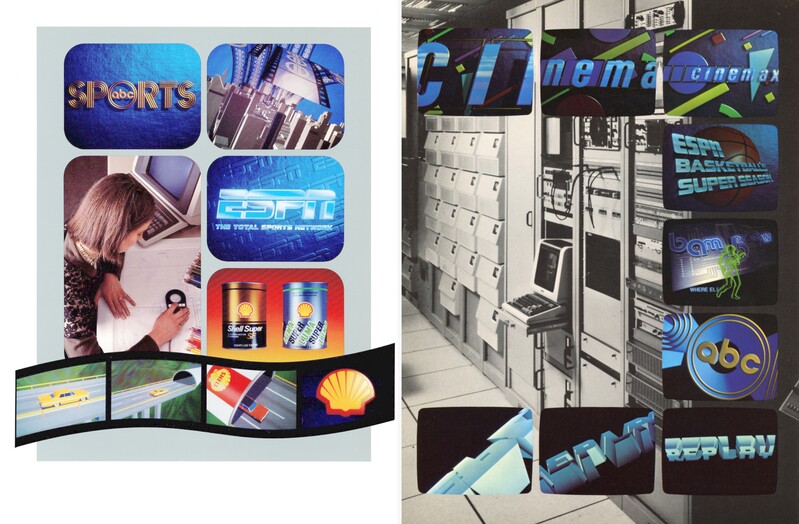
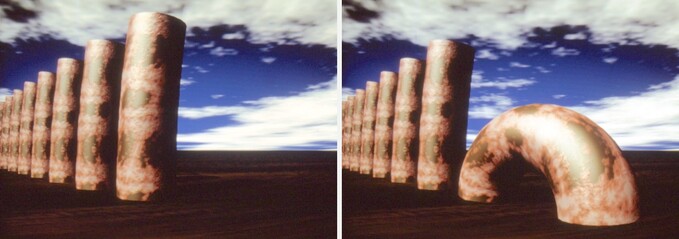
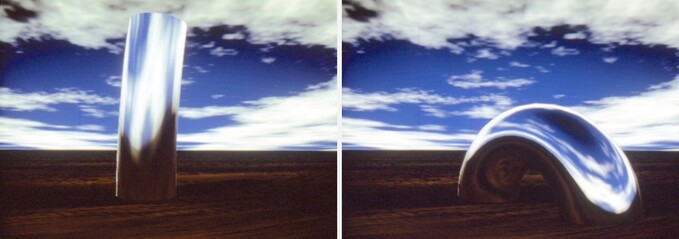
We still had faith in the displacement shader and I continued playing with it in my free time, coming up with some interesting personal images, like these below...
Finally, our work with the shader led to a delightful animation project with Orest Woronewych and Mark Tekushan at Cinemax.
Around the middle of 1985, Digital Effects, a pioneering New York City CG company, closed its doors. As a result, Carl Frederick, another math whiz and coder, and former Digital Effects employee, came to work with us at Omnibus.
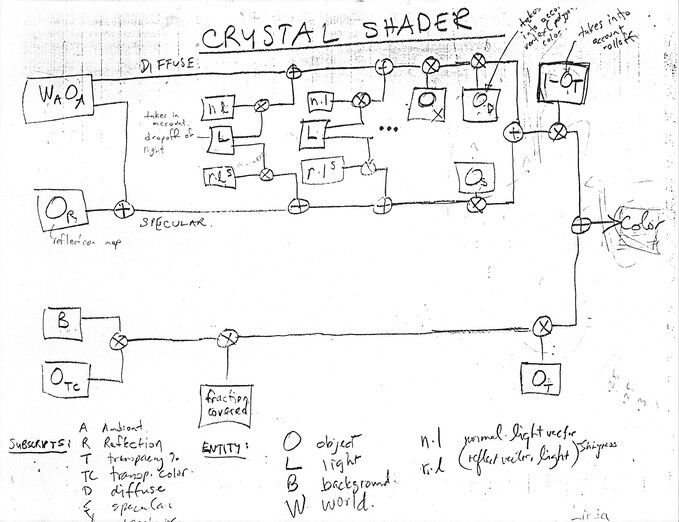
Dave Gordon was already planning to write a new A-buffer renderer, so he and Carl starting working on the project together. This led to "Crystal" a much more advanced renderer than what we had been using up to that time.
Omnibus NY 1985
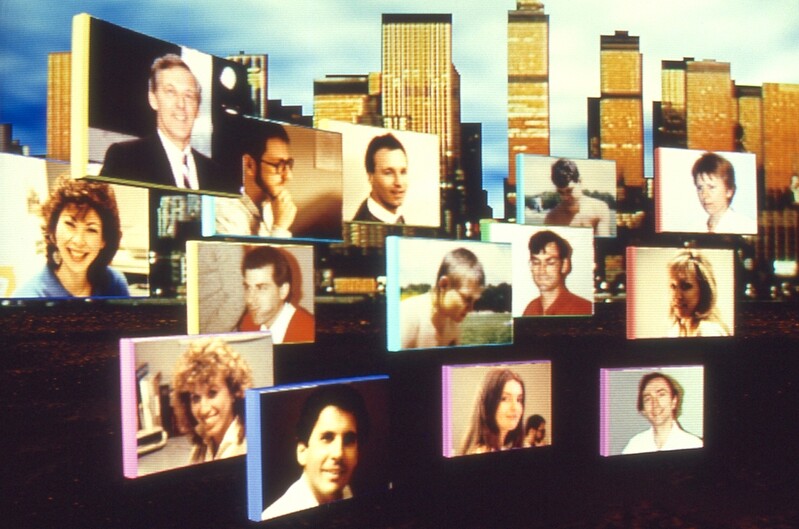
Top: George Heywood, Stan Cohen, Floyd Gillis, Carl Frederick, Paula Blashka
Middle: Paula Tannenbaum, Henry Frenzel, Rodian Paul, Erik Ladd, Barbara Levy
Bottom: Nadeen Kaplan, Jeff Marvin, Sonya Hafferkorn, Dave Gordon
The First (and only) Annual Omnibus NY Canoe Expedition
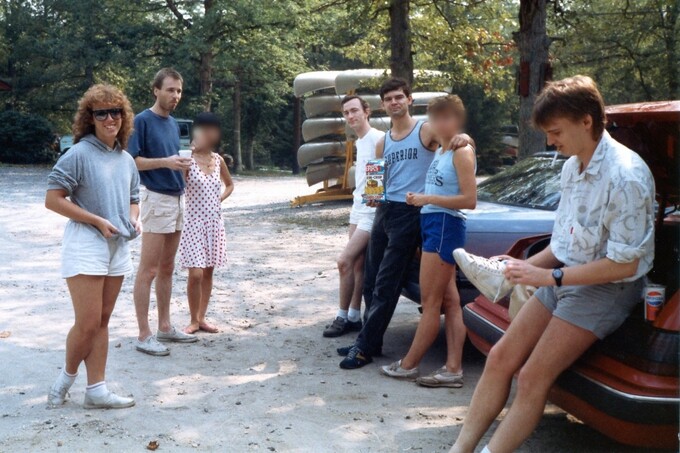
Our "expedition" on a New Jersey river wasn't that enjoyable. The water-level was so low, we spent most of our time stumbling along the river bed, dragging the canoes behind us.
Satellite Connections
All three facilities were humming along nicely. L.A. was focused on Hollywood film work, New York was doing projects with Madison Avenue ad agencies and national broadcasters, and Toronto was the hub for R&D and software development, along with their continuing work on commercial CG and video productions.
It was one of John Pennie's dreams to have all three locations connected seamlessly, allowing assets and resources to be shared and transferred quickly to where they were needed most. The internet, as we know it today, didn't exist, so a satellite connection was established between the three facilities. I don't know if the cost was a fixed monthly rate or based on bandwidth usage, but I do know it was expensive.
We had a simple email system between all the studios, which was great, but transfer speeds were slow and almost impractical for large files.
One "trick" we loved to demonstrate was to send an image file, via satellite, through all three Omnibus facilities. From one of our VT-100 terminals in New York, we'd transfer an image file to Toronto. Then, we'd log-in to Toronto and repeat the process to L.A. From L.A. we'd repeat the process back to New York, and run the command (from L.A.) to display the image on a monitor sitting on the desk beside us. I often wonder how much those little "demonstrations" cost the company.
Initially unknown to us at the time, "accounting" software had been installed at all the facilities that would automatically report back to Toronto headquarters. This included information on how much time people were spending on the computers and what processes they were running.
One day, Kevin Tureski, the systems administrator in Toronto, called Dave and asked about a process called "Hack", (or "Nethack"). Apparently, there were copies of it running for several hours each day on our VAX in New York.
Dave said he wasn't aware of it, thanked Kevin for the alert, and told him he would look into it right away. What he didn't tell Kevin was that "Hack" was a text-based dungeons-like game that he, Carl, and Rod were playing for hours at a time, almost every day.
Dave promptly changed the name of the game to a version of "Crystal" (our new rendering software) and "solved" the problem.
Headquarters must have been impressed by the sudden increase in rendering activity at the New York studio.
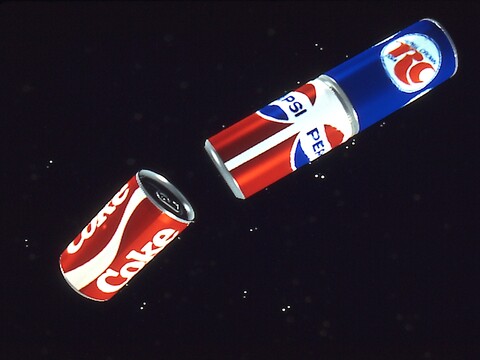
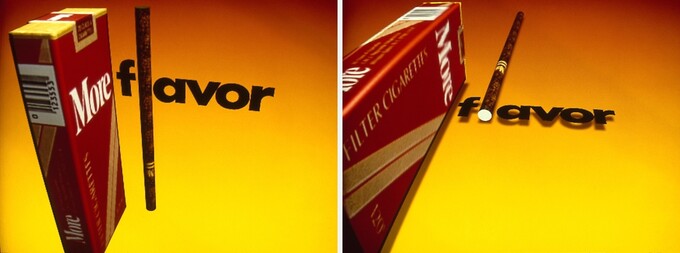
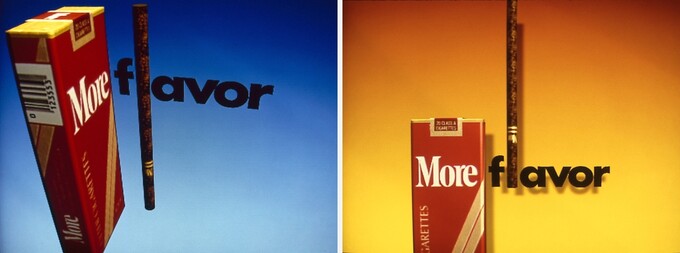
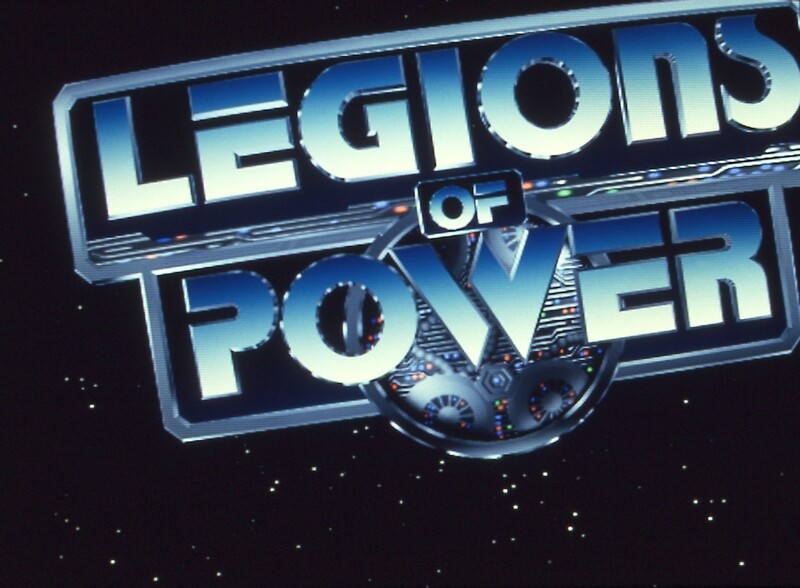
Legions of Power
This was a fun project, but with the primitive data generation tools we had at the time it was quite a challenge to create the detailed geometry for all the toy's separate pieces. Thankfully, engineering blueprints of the individual components were provided by Tonka's manufacturing team in Japan.
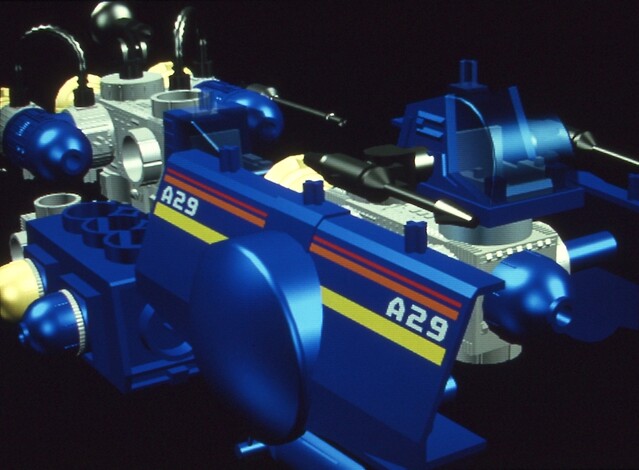
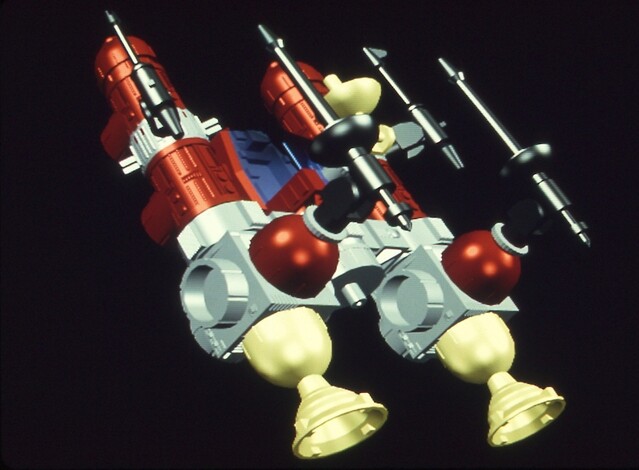
I loved these toys, and may still have a box of them in a storage locker, somewhere.
Additional Production Details and Credits
A three week project with a budget of approximately $20,000.00 US.
Client: Tonka Corporation
Agency: Jordan, Case, Taylor and McGrath Inc.
Producer: Jeff Weitzer (JCTM)
Creative Directors: Floyd Gillis, Rod Paul
Account Director: Jeff Marvin
Animation: Rod Paul
3D Modelling: Stan Cohen, Floyd Gillis, Dave Gordon, Sonya Hafferkorn, Rod Paul
Technical Directors: Dave Gordon (Software), Henry Frenzel (Video)
Production Co-ordinator: Nadeen Kaplan
Toyota Mountain
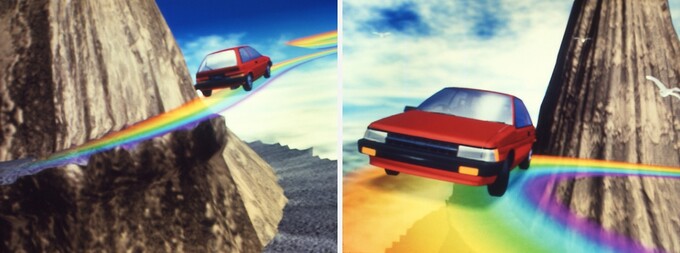
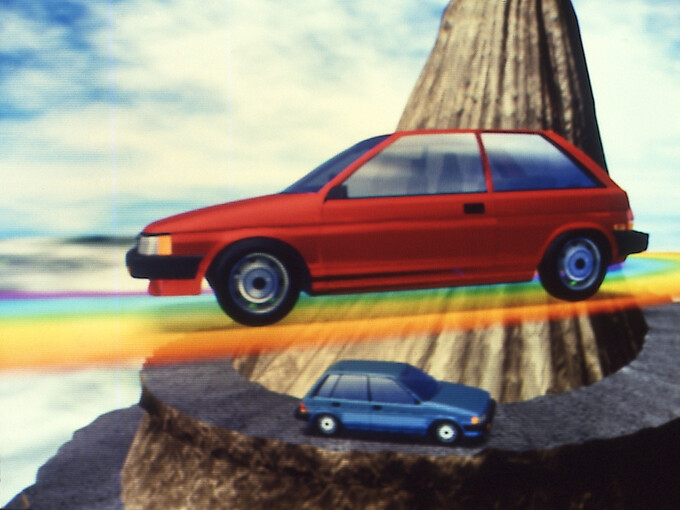
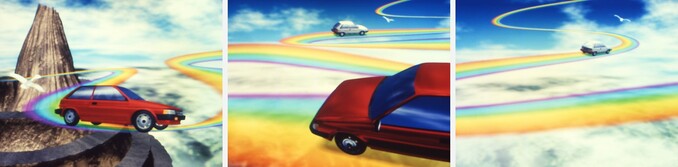
A 30 second commercial created for the Canadian launch of the 1987 Toyota Tercel. Mark Joiner used CAD/CAM data, (supplied by Toyota, Japan), as reference material for building the 3-D geometry of the car(s).
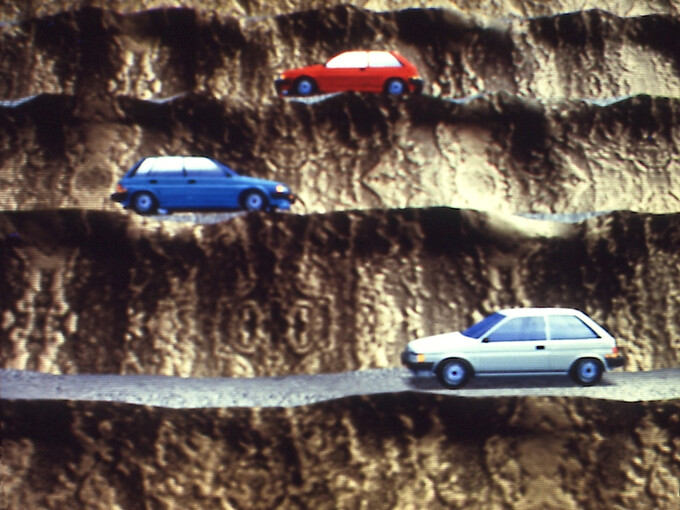
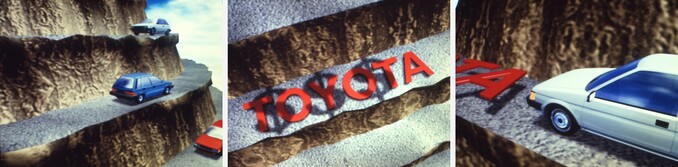
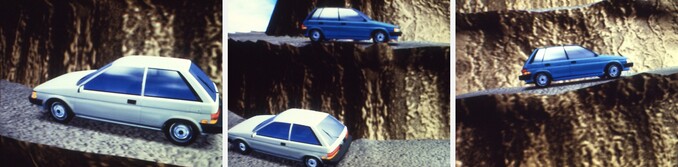
Additional Production Details and Credits
A three and a half month project with a budget of approximately $90,000.00 US.
Client: Toyota, Canada
For Toyota: Tom Woodside (National Manager, Marketing Services), Doug Lunau (Advertising Manager), Hiro Okabe (Executive Co-ordinator)
Agency: Dancer, Fitzgerald, Sample, Inc. (US), Ronalds, Reynolds, Inc (Canada)
Producer: Phil Weigand (RR)
Creative Directors: P.A. Tippet (DFS), Ken Lombardo (DFS), Floyd Gillis, Rod Paul
Account Directors: Barbara Levy, Sandy Podminsky (DFS), John Luciani (RR)
Animation: Rod Paul, Carl Frederick, Mark Joiner
3D Modelling (Cars): Mark Joiner
3D Modelling (Environment): Floyd Gillis, Sonya Hafferkorn, Rod Paul
Technical Directors: Dave Gordon (Software), Henry Frenzel (Video)
Production Co-ordinator: Nadeen Kaplan
Acquisitions
Finally, Omnibus NY was coming together as a productive CG facility. We had made it through that first difficult year, opening without any software, and then struggling with the very buggy "scn_dis_assmblr".
We now had decent software for data generation, animation, and rendering, and our team was comfortable with the production "pipeline", (if you could call it that in those days). The quality of our animations was being recognized and we were feeling proud of our work.
The atmosphere in the NY studio was upbeat.
In June of 1986, Omnibus acquired Digital Productions for around 12 million dollars.
In September, Omnibus acquired Robert Abel & Associates for around 7.3 million dollars.
We were now working at the largest computer animation company in the world. Woo-Hoo!
It was the beginning of the end.
Robert Abel became the Uber-Creative Director of Omnibus and, officially, my immediate boss. It wasn't long before I was back in L.A. where it was arranged for Rod and me to meet with "Bob".
Damn! This was the man behind "High Fidelity", "Sexy Robot", and so many other award-winning commercials. Robert Fuckin' Abel!
We were escorted into "Bob's" office, shook hands, introduced ourselves, sat down, and had a nice discussion about... I have no idea. I can't remember a single word from that meeting. But, it probably included some bowing and scraping and pledges of everlasting allegiance to "Bob", on my part.
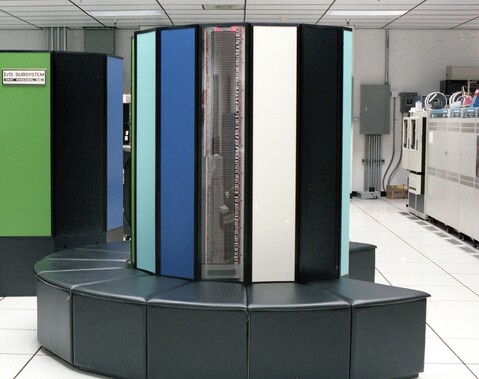
Before heading over to our meeting with Robert Abel, I had stopped by the Digital Productions facility and spent some time standing inside their Cray computer.
Perhaps that fried my brain.
The Mind
Omnibus NY was awarded the graphics and animations contract on a large co-production between PBS and BBC. The series of nine, one-hour programs was based on "The Mind", a book by Richard Restak, an American neurologist, neuropsychiatrist author, and professor.
This was a high-profile project with a good budget and a one-year production schedule. And, most of the work would be going through WNET, the PBS affiliate located just a few blocks from us on West 58th Street.
A major highlight of the series was to be the computer generated animation segments using highly detailed 3D models of the brain and its interior structures. Of course, that 3D geometry of the brain didn't exist at the time, and creating it would be our big challenge on the project.
The producers at WNET arranged for me to meet with Dr. Robert B. Livingston, one of the world's leading brain researchers at the time. He and his group had also been creating detailed databases of the brain by hand digitizing thousands of extremely thin slices of 2D cross-sections of the human brain.
I went to San Diego and spent an afternoon with Dr. Livingston at the Salk Institute for Biological Studies at La Jolla. He gave me a crash course in brain structures, how the 2D cross-sections were created, and how the resulting (massive) database of 2D slices were organized.
Thanks to PBS, and their friends in high places, Dr. Livingston granted me permission to use one of "his brains" on the PBS project and, in return, I promised to send him a copy of the 3D geometry models when they were completed.
Back in New York, it soon became clear we didn't have the software tools necessary to edit and loft the large number of 2D cross-sections and create accurate and usable 3D surface geometry.
I embarked on my biggest programming journey to date, and began writing an interactive lofting program, (using "C"), to run on the Silicon Graphics workstation.
Meanwhile, things started going downhill at Omnibus.
It's not clear whether John Pennie was fully aware of it at the time, but both Digital Productions and Robert Abel & Associates were not only close to bankruptcy, they were also millions of dollars in debt when he acquired them.
On top of that, a major stock issue was scuttled when the validity of "assets" like, 3-D geometry libraries, sales of software licenses, and so on, were called into question.
It wasn't long before John came down to NY to hold a general staff meeting where he announced the closure of the New York facility.
WTF?
Everyone was in shock. Not only were people losing their jobs, but for the previous couple of years, most of us had been forgoing raises and accepting stock options instead. And, the value of Omnibus stock was becoming worthless.
Carl found this cartoon, (Kliban's "The Food and Drug Administration"), and added the names of Omnibus NY staff. I added the shark and Omnibus logo, and it was faxed to the other Omnibus facilities.
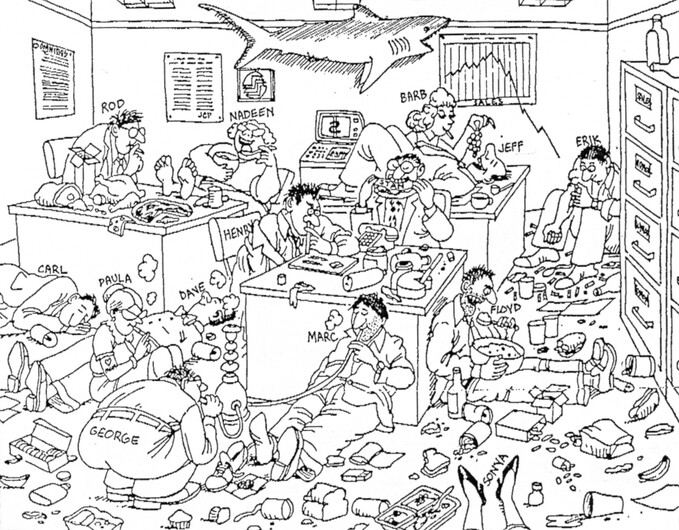
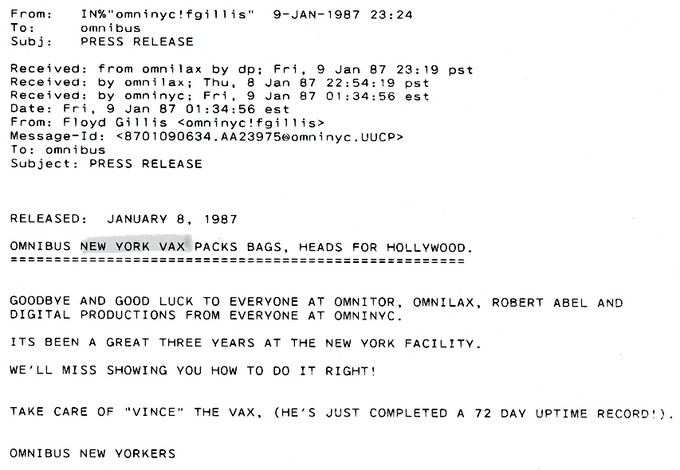
Due to the scale of the PBS/BBC project, and WNET's insistence that the CG animation production remain in New York, Jeff, Dave, and I were asked to stay on, (in a mostly empty building), and continue working on "The Mind".
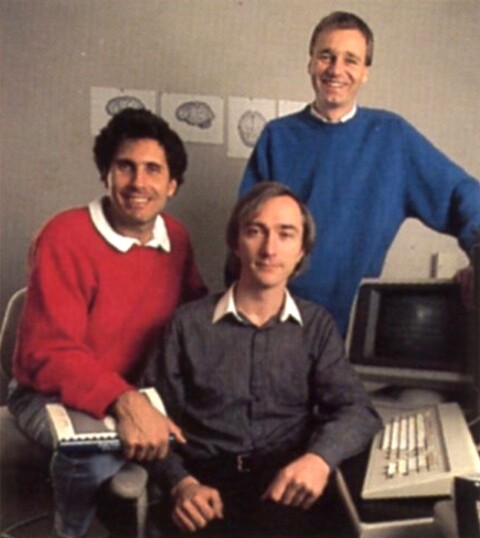
Jeff would be the producer on the project and, (thanks to his many New York client contacts), continue with sales and channel any new commercial work to Toronto and L.A.
Dave would be available to provide technical support for "The Mind" and, (as an important part of Omnibus R&D), continue to work on in-house software development.
I would continue on as creative director, animator, etc. I was also put "in charge" of the NY office and given signing authority on the Omnibus NY bank account. But, since payroll was handled by the Toronto office, and utilities went through Unitel, I never had to write cheques or do any "banking".
The PBS project moved into high gear, and I continued developing my interactive lofting program, becoming intimate with the cross-section data of the brain, and working closely with Richard Hutton and Bonnie Benjamin at WNET on the 3D animation and graphics requirements for "The Mind".
Kleiser Walczak Construction Company
Jeff Kleiser, one of the founders of NY's "Digital Effects", was hired by John Pennie to run the "Motion Picture Special Effects Division" of Omnibus. Jeff had extensive movie experience, creating effects for feature films like "TRON" and "Flight of the Navigator". He also had great connections in the film industry.
Before his planned move to L.A., Jeff was given a temporary space at Omnibus NY, and I would occasionally bump into him at the studio. Eventually, we ended up working together on a small test project. From the little I knew, it was a pitch to Marvel Comics for a 3D animated super-hero character. Somehow, "The Stigwood Group" was also involved.
Sculptor, Dianne Walczak, did a great job creating the separate sections of the super-hero body in plaster, (foot, lower leg, thigh, torso, etc.), and Jeff digitized them using the Polhemus 3D digitizer.
Jeff then passed along the 3D models to me. I set-up the body hierarchy, and animated and rendered the character. It was a fast turn-around, but we ended up with an impressive little animation of around 5 seconds.
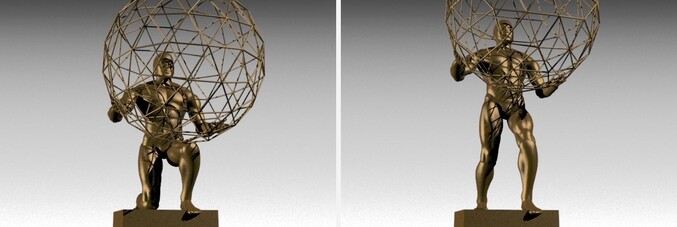
I enjoyed working with Jeff, but never heard back from him about his meeting with Marvel.
In hindsight it's easy to see how this was such a ridiculous idea... Marvel Comics superheroes and computer animation? Pffft!
Closing of Omnibus
Things were still not going well and trading of Omnibus stock on the TSE (Toronto Stock Exchange) was halted in March of 1987 when Omnibus "defaulted on provisions of its line of credit with its Canadian Banker"*.
We assumed this was the end.
William Kennedy was brought in to replace John Pennie as President and CEO, and Omnibus bounced back with new funding, (Crownx & National Sea Products), and the stock resumed trading again.*
An "All Staff" meeting was held in L.A. (I wasn't there, but heard about it from others who were) where Omnibus management assured everyone that the company had made it through their financial difficulties and was now moving forward with great optimism.
A large bag was brought in, supposedly containing several million dollars in cash. Security guards on either side of the stage went into defensive positions, with hands twitching over their guns.
Management was trying to bamboozle their own employees! It was all so ridiculously theatrical.
They also insisted it was now a great time to buy Omnibus stock, and encouraged employees to invest before the price zoomed up again. Some did. I sold everything I could find.
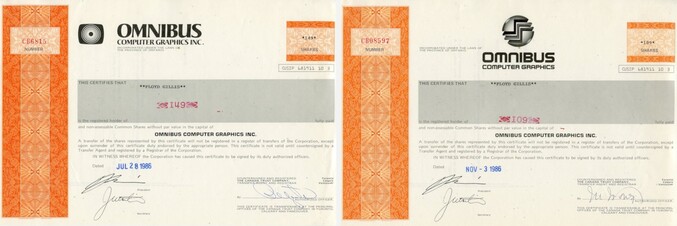
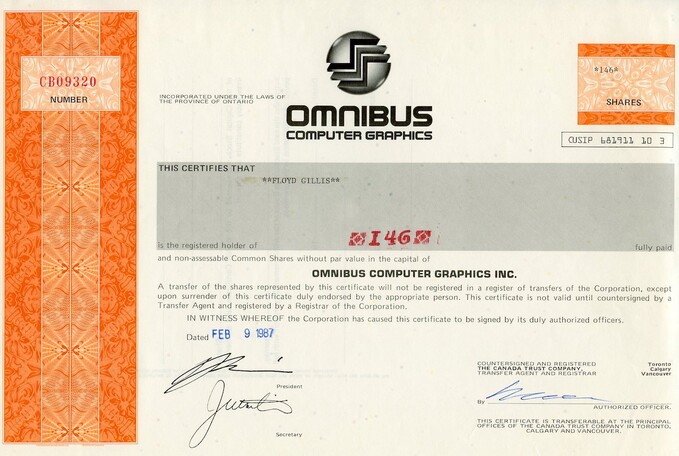
Well, the reprieve didn't last long. By mid-April Omnibus was burdened with around 30 million in debt, and everything came crashing down.
Crownx and National Sea Products couldn't come to an agreement with the Royal Bank of Canada on a proposed restructuring plan, and William Kennedy resigned as president and CEO. Trading of stock on the TSE was halted, again.*
Finally on May 11th, Omnibus was suspended from the TSE, after a month-long trading halt.*
"DOA" day arrived and Digital Productions, Omnibus, and Abel were no more.
Employees arriving at the offices in Toronto found the doors literally chained shut.
I don't know what the situation was like in L.A., but in NY we were still able to enter the building. (Did they forget about the 3 of us?)
Painfully, we were each owed several weeks salary, and didn't see any hope of ever receiving it.
By some great fortune, a late payment cheque of around $30,000.00 arrived in the mail from ESPN. Jeff and Dave insisted we split it, but I took my "responsibilities" seriously and refused, "because the money didn't belong to us".
Thankfully, my wife talked some sense into me, arguing that, not only did Omnibus owe us the money, but they had misled and then abandoned their employees. And, senior management surely knew what was coming and had already taken what they could.
So, finding that the Omnibus NY bank account was still active, I deposited the payment from ESPN. Then, exercising my "signing authority", I immediately wrote 3 cheques to make up for our lost salaries. The money covered everything we were owed, except for some sales commissions Jeff was expecting.
AFCG Inc.
I broke the news about Omnibus to WNET. Richard and Bonnie were not happy about the situation, but made it clear they wanted me to continue working on the project.
They also made it clear that if I were to take over the CG production for "The Mind", I would need to incorporate, first.
Bless them!
It was a mad scramble to come up with alternative ways to continue working on the project.
I was in talks with the bank holding Omnibus NY's assets to purchase the SGI workstation and some other smaller pieces of equipment, but I couldn't raise the money.
Then, Dave, Rod, Jeff, and I were in discussions to buy the equipment together and start a new company to work on the PBS project, and other productions. That fell through.
I also considered taking the project to other CG facilities in the New York area.
Finally, I made a deal with Scott Gordon, one of the principals at "Post Perfect", a new company constructing a state-of-the-art post production and 3D animation facility in the Daily News Building on East 42nd Street.
Following Richard and Bonnie's advice, I incorporated (as AFCG, Inc.) and for almost a year, (from midnight to 8:00 AM), rented Post Perfect's Quantel Paintbox, Harry, and one of their SGI workstations, and created all the CG animation and graphics for "The Mind".



Looking back, I've come to realize I was (and still am) a bit of a perfectionist and have difficulty delegating authority. I was probably a terrible boss.
My belated apologies to anyone who may have suffered under my poor management skills back then.